| Citation: |
A. Ben Jazia Kharrat. Multiscale transport and first-principles investigation of Pr0.5-xGdxSr0.5MnO3 (0 ≤ x ≤ 0.3) perovskites: from polaronic conduction to interface-driven dielectric relaxation[J]. Materials Lab, 2026, 5(2): 260111. doi: 10.54227/mlab.20260111

|
Multiscale transport and first-principles investigation of Pr0.5-xGdxSr0.5MnO3 (0 ≤ x ≤ 0.3) perovskites: from polaronic conduction to interface-driven dielectric relaxation
-
Abstract
In this work, we present a comprehensive investigation of the structural, electronic, and dielectric properties of Gd-substituted Pr0.5-xGdxSr0.5MnO3 (0≤x≤0.3) perovskites using a combined experimental reinterpretation and first-principles approach. Structural distortion induced by Gd incorporation leads to significant modifications in charge transport mechanisms. Direct Current (DC) conductivity reveals thermally activated behavior governed by small polaron hopping, while Alternating Current (AC) conductivity exhibits a transition between Drude-like metallic response and Jonscher-type dispersive conduction. Impedance spectroscopy confirms dominant grain-boundary contributions and non-Debye relaxation. Density Functional Theory (DFT) calculations reveal progressive band narrowing and increased carrier localization with increasing Gd content, consistent with experimental activation energies. The correlation between electronic structure and transport properties is established, providing a predictive framework for defect-engineered manganites. The results highlight the crucial role of interfacial effects and carrier localization in governing the functional properties of complex oxide materials.
-
Keywords:
- Perovskites /
- DFT /
- Manganites /
- Charge transport /
- Impedance spectroscopy /
- Dielectric relaxation
-

-
References
1. N. Q. Minh, J. Am. Ceram. Soc., 1993, 76, 563–588 2. Z. C. Xia, S. L. Yuan,W. Feng, L.J. Zhang, G.H. Zhang, J. Tang, L. Liu, D.W. Liu, Q.H. Zheng, L. Chen, Z.H. Fang, S. Liu, C.Q. Tang, Solid State Commun., 2003, 127, 567–572 3. N. Khare, D. P. Singh, A. K. Gupta, J. Phys. Chem. Solids, 2004, 65, 867–870 4. W. Boujelben, M. Ellouze, A. Cheikh-Rouhou, J. Pierre, J.C. Joubert, J. Solid State Chem., 2002, 165, 375–380 5. A. K. Pramanik, A. Banerjee, J. Phys. Condens. Matter, 2008, 20, 275207 6. L. Chen, Y. Ma, J. Magn. Magn. Mater., 2012, 324, 1189–1192 7. M. Bourouina, A. Krichene, J. Alloys Compd., 2016, 680, 67–72 8. R. Jemai, H. Rahmouni, J. Alloys Compd., 2017, 693, 631–641 9. H. Rahmouni, B. Cherif, K. Khirouni, J. Alloys Compd., 2014, 591, 259–262. 10. J. Shanker, R. Vijaya Kumar, J. Alloys Compd., 2018, 732, 314–327 11. S. Das, S. Sutradhar, J. Alloys Compd., 2017, 726, 11–21 12. A. Ben Jazia Kharrat, M. Bourouina,N. Moutia, K. Khirouni, W. Boujelben, J. Alloys Compd., 2018, 741, 723–733 13. C. Zener, Phys. Rev., 1951, 82, 403–405 14. P. W. Anderson, H. Hasegawa, Phys. Rev., 1955, 100, 675–681 15. N. F. Mott, Metal–Insulator Transitions, Taylor & Francis, London, 1990. 16. D. Emin, Phys. Rev. B, 1993, 48, 13691–13702 17. A. K. Jonscher, Nature, 1977, 267, 673–679 18. K. Funke, Prog. Solid State Chem., 1993, 22, 111–195 19. J. C. Giuntini, J. Non-Cryst. Solids, 2002, 305, 65–70 20. A. Ghosh, J. Appl. Phys., 1997, 81, 1270–1275 21. C. Kittel, Introduction to Solid State Physics, Wiley, 8th ed. ,2005. 22. N. W. Ashcroft, N. D. Mermin, Solid State Physics, Holt, Rinehart & Winston ,1976. 23. J. P. Perdew, K. Burke, M. Ernzerhof, Phys. Rev. Lett., 1996, 77, 3865–3868 24. G. Kresse, J. Furthmüller, Phys. Rev. B, 1996, 54, 11169–11186 25. S. L. Dudarev, G. A. Botton, Phys. Rev. B, 1998, 57, 1505–1509 26. H. Fjellvåg, Egil Gulbrandsen, Siv Aasland, Arne Olsen, Bjørn C. Hauback, J. Solid State Chem., 1996, 124, 190–194 27. E. Dagotto, Nanoscale phase separation in manganites, Springer Series ,2003. 28. Y. Tokura, Rep. Prog. Phys., 2006, 69, 797–851 29. J. B. Goodenough, Phys. Rev., 1955, 100, 564–573 30. A. R. West, Solid State Chemistry and Its Applications, Wiley, 2014. -
Rights and permissions
This is an open access article under the terms of the Creative Commons Attribution License, which permits use, distribution and reproduction in any medium, provided the original work is properly cited.
Figures(6)
Tables(3)
Information
Article Metrics
Export File
Citation
A. Ben Jazia Kharrat. Multiscale transport and first-principles investigation of Pr0.5-xGdxSr0.5MnO3 (0 ≤ x ≤ 0.3) perovskites: from polaronic conduction to interface-driven dielectric relaxation[J]. Materials Lab, 2026, 5(2): 260111. doi: 10.54227/mlab.20260111
Format
Content
 DownLoad:
-
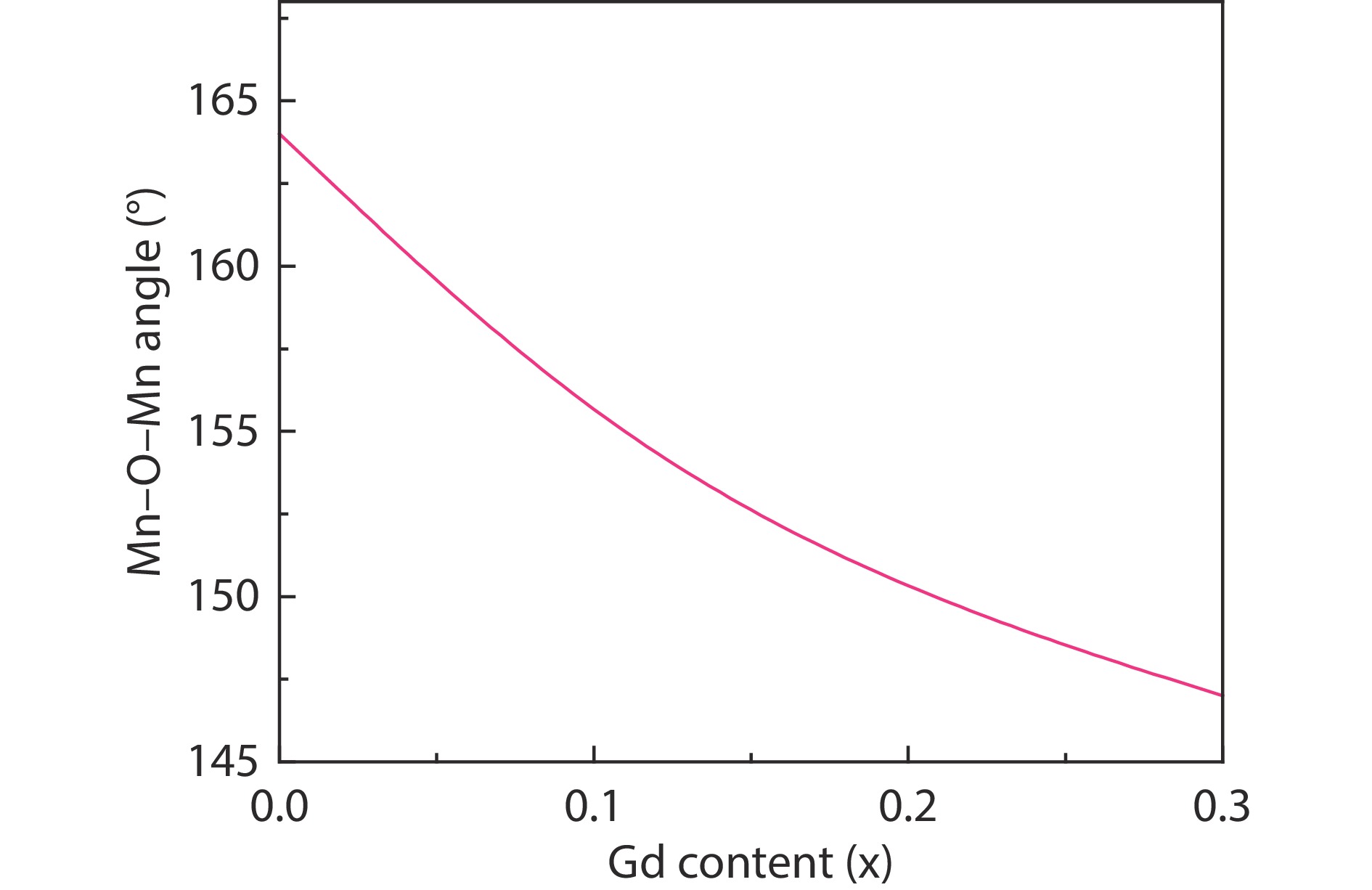
Figure 1.
Evolution of structural distortion as a function of Gd content in Pr0.5-xGdxSr0.5MnO3 compounds. The progressive decrease of the Mn-O-Mn bond angle reflects the increasing tilting of MnO6 octahedra induced by Gd substitution, leading to reduced orbital overlap and a weakening of the double-exchange interaction. This structural distortion plays a central role in the transition from delocalized to localized charge transport.
-
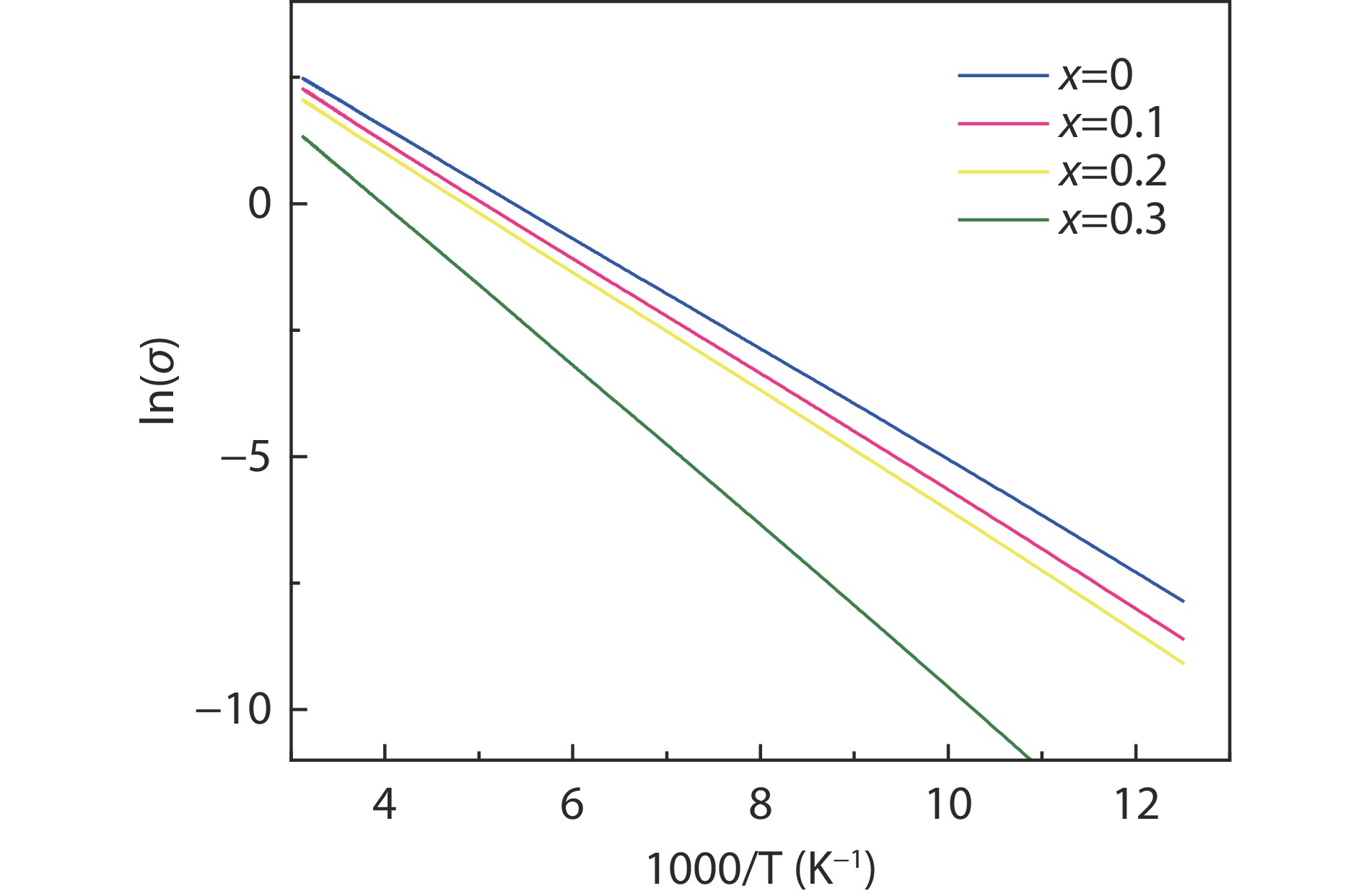
Figure 2.
Temperature dependence of DC electrical conductivity represented in Arrhenius form for different Gd concentrations. The linear behavior confirms a thermally activated conduction mechanism, while the increase in slope with Gd content indicates a rise in activation energy associated with enhanced carrier localization and disorder-induced scattering.
-
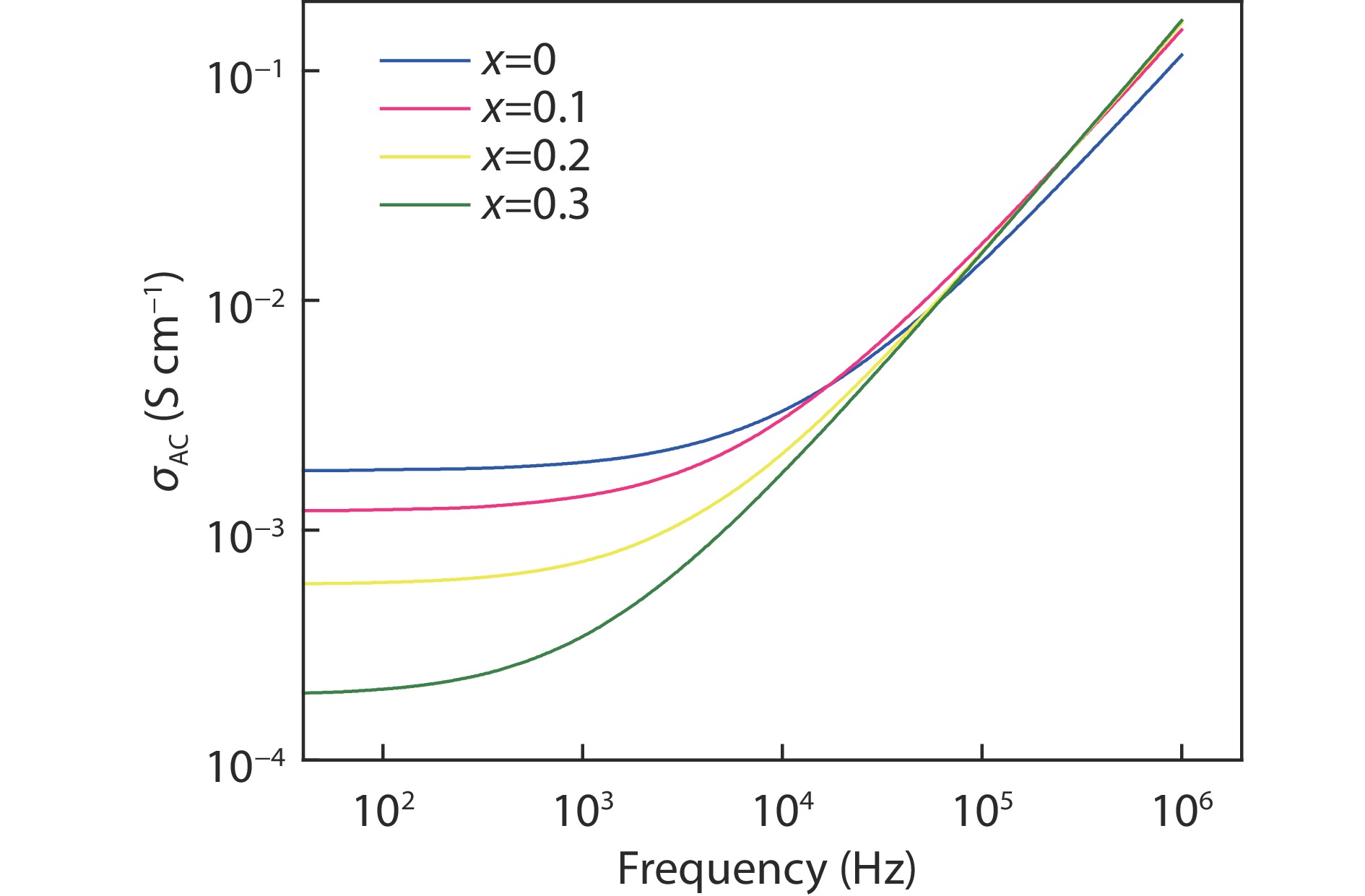
Figure 3.
Frequency dependence of AC conductivity at different temperatures and compositions. The low-frequency plateau corresponds to DC conductivity, whereas the dispersive high-frequency region follows Jonscher’s power law, revealing a hopping conduction mechanism. The variation of the exponent reflects the transition between different transport regimes influenced by Gd substitution.
-
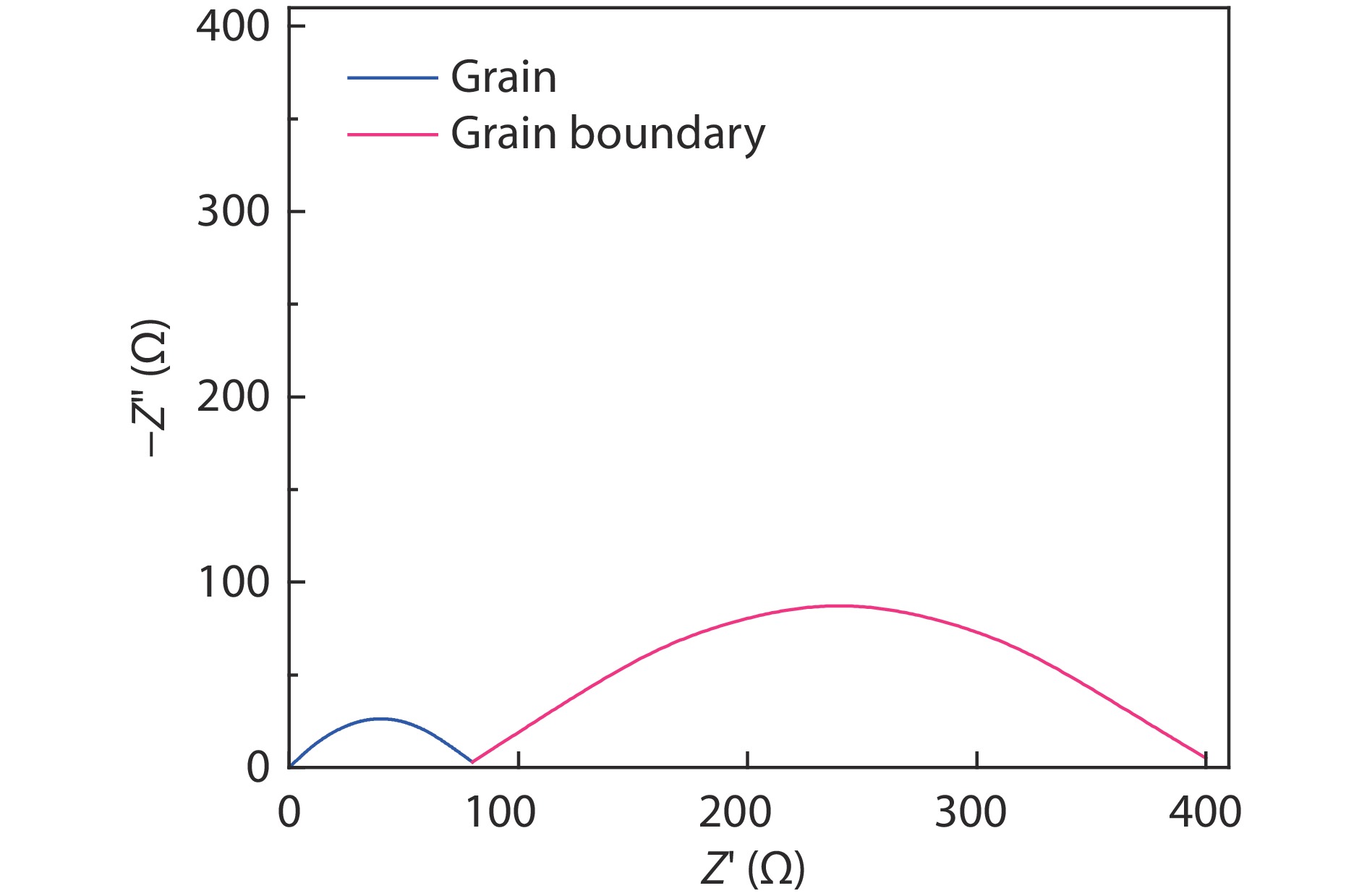
Figure 4.
Nyquist plots of complex impedance for Gd-substituted samples at selected temperatures. The presence of two depressed semicircles indicates distinct contributions from grains and grain boundaries, while their evolution with temperature highlights the thermally activated nature of charge transport. The deviation from ideal semicircular behavior reflects non-Debye relaxation and structural heterogeneity.
-
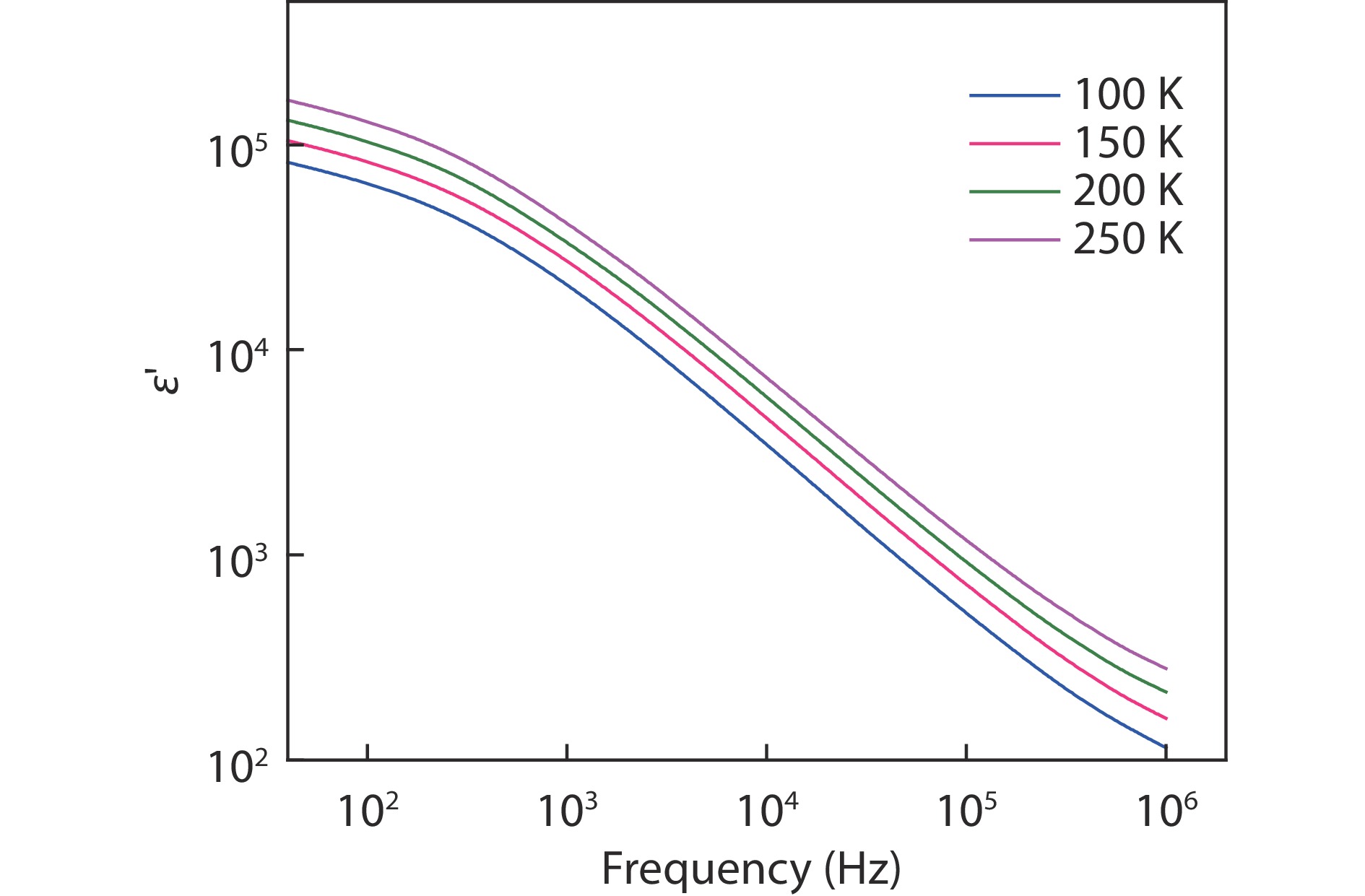
Figure 5.
Frequency dependence of dielectric permittivity for representative temperatures. The high permittivity observed at low frequencies is attributed to Maxwell–Wagner interfacial polarization, whereas the rapid decrease with increasing frequency reflects the inability of dipolar and space charge polarization mechanisms to follow the alternating electric field.
-
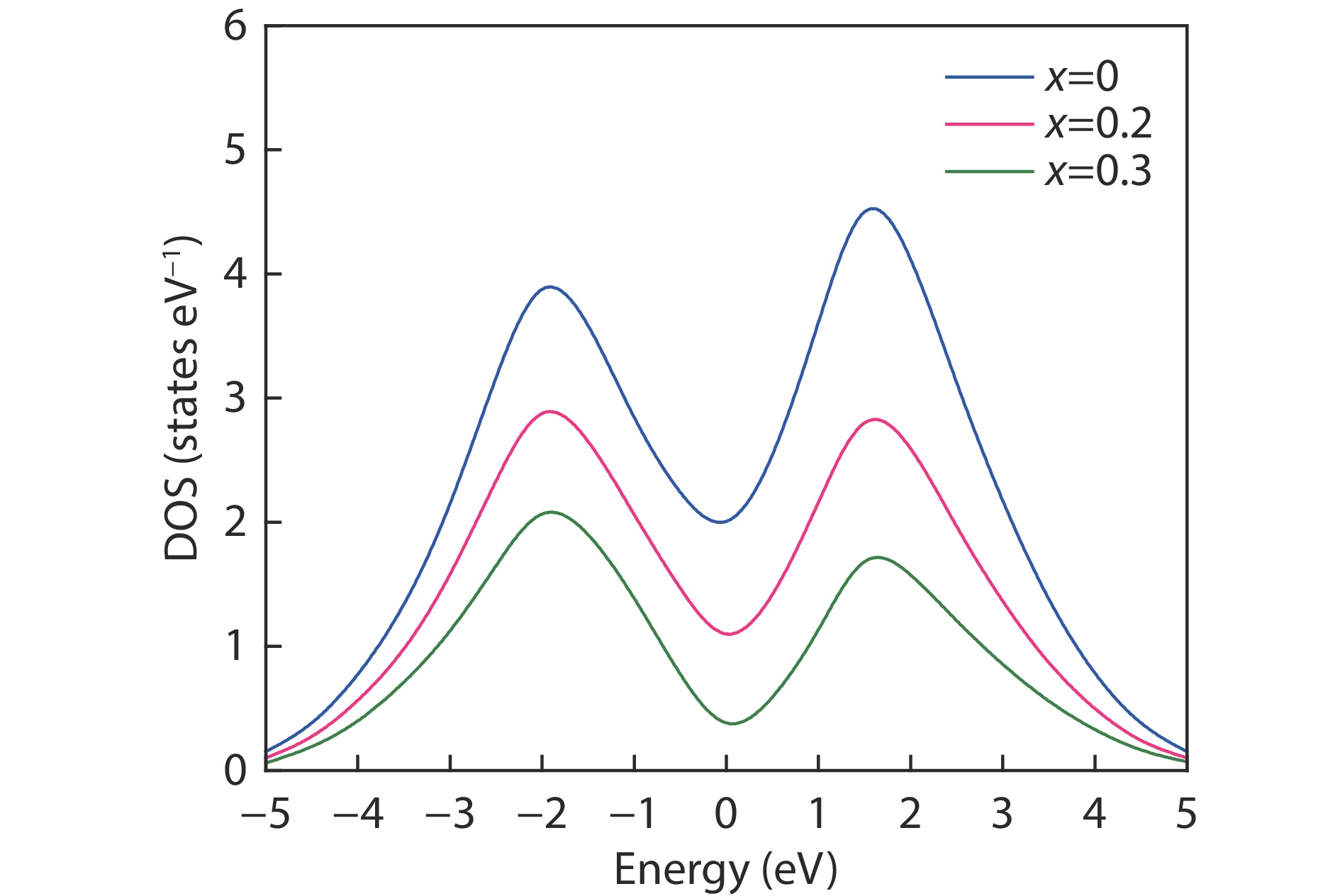
Figure 6.
Calculated density of states illustrating the effect of Gd substitution on the electronic structure. The progressive narrowing of the electronic bands and the reduction of states near the Fermi level indicate increased carrier localization, in agreement with the experimentally observed increase in activation energy and decrease in electrical conductivity.