| Citation: |
Xiaolong Hong, Zhiwei Qin, Jiachen Li, Jilong Wang, Bingzhi Wang, Wenhao Wang, Fushuai Jin, Peng Li, Honggang Dong. Suppressing interfacial defects toward high-performance diffusion bonded FGH99 superalloy via a sandwich-structured interlayer[J]. Materials Lab, 2026, 5(1): 250104. doi: 10.54227/mlab.20250104

|
Suppressing interfacial defects toward high-performance diffusion bonded FGH99 superalloy via a sandwich-structured interlayer
-
Abstract
Interfacial voids and unbonded defects acted as stress concentration sites that significantly degraded the mechanical properties and directly compromised the structural integrity and service life of critical components. Herein, an innovatively Ni/Cr0.625-Al2.875/Ni sandwich-structured interlayer was designed to achieve high-quality diffusion bonding of FGH99 superalloy by regulating interfacial diffusion and recrystallization behavior. The results demonstrated that Ni foil effectively promoted the closure of interfacial voids and induced the formation of a graded interfacial structure, including the Ni transition zone (NTZ) and the interlayer diffusion zone (IDZ). This structure provided high-density grain boundaries as fast diffusion channels for elements, and served as an in-situ reaction container for the precipitation of γ′ strengthening phases. The shear strength of the joint with the sandwich-structured interlayer reached 857.7 MPa, which increased by 67.6 MPa compared to that of the single-layer interlayer. The fracture path of the joint transformed from the original bonding interface to the NTZ/IDZ interface. The fracture surface exhibited lots of fine dimples, indicating a transition from weak interfacial bonding to bulk strengthening and toughening of the joint. This work elucidated the mechanism of void closure and microstructural evolution mediated by the Ni interlayer, providing important theoretical support for the development of high-performance Ni-based superalloy diffusion bonding technology.
-

-
References
1. D. Zhang, W. Liu, Y. Li, D. Sun, Y. Wu, S. Luo, S. Chen, Y. Tao, B. Zhang, Nat. Commun., 2023, 14, 2961. 2. C. C. Silva, R. S. Silva, É. M. Miná, M. F. Motta, H. C. Miranda, G. Dalpiaz, R. R. Marinho, M. T. P. Paes, A. K. da Silva, I. Wossack, C. H. Liebscher, J. Mater. Sci. Technol., 2026, 254, 168–179. 3. H. Xu, Z. J. Zhang, P. Zhang, C. Y. Cui, T. Jin, Z. F. Zhang, Sci. Rep., 2017, 7, 8046. 4. M. Sakaguchi, K. Mase, I. Sasakura, S. Tanaami, T. Fukuda, Int. J. Fatigue., 2026, 203, 109309. 5. O. Takakuwa, Y. Ogawa, R. Miyata, Sci. Rep., 2023, 13, 6804. 6. Y. Chen, Z. Yao, H. Wang, J. Dong, J. Peng, M. Ren, H. Yang, L. Leng, Eng. Fail. Anal., 2025, 179, 109797. 7. T. Wu, C. Wang, Y. Liu, Q. Zhang, P. Lin, X. Yue, T. Lin, P. He, J. Mater. Sci. Technol., 2025, 226, 181–195. 8. Y. Ding, D. Wen, X. Wang, B. Kong, Z. Gong, Y. Wang, H. Lai, Y. Xu, X. Yang, S. Wang, Y. Sun, Int. J. Refract. Met. Hard Mater., 2025, 133, 107302. 9. R. Chang, Q. Guo, Z. Ma, R. Ding, C. Liu, Y. Liu, Acta Mater., 2024, 276, 120121. 10. C. Li, Y. Li, D. Zhang, X. Li, W. Zhao, J. Mater. Res. Technol., 2023, 26, 4042–4058. 11. T. Wu, Y. Liu, Q. Zhang, K. Li, R. Xu, H. He, C. Wang, P. Lin, X. Yue, T. Lin, P. He, J. Manuf. Process., 2024, 128, 60–71. 12. J. Lin, X. Li, C. Wang, R. Xu, X. Zhang, F. Lu, P. Lin, H. Mei, Y. Liu, Y. Zhuang, P. He, T. Lin, Compos. Part. B. Eng., 2023, 260, 110771. 13. J. Wang, Z. Qin, P. Li, Z. Ding, P. Zhao, B. Wang, X. Ma, H. Sun, Y. Cheng, Y. Chang, H. Dong, Intermetallics, 2025, 185, 108916. 14. S. Zhao, B. Shao, H. Chen, Y. Hu, Z. Pan, Y. Liu, P. Wang, X. Song, W. Li, J. Mater. Sci. Technol., 2025, 233, 223–238. 15. P. Wang, W. Liu, L. Gu, H. Ran, X. Song, Z. Pan, H. Chen, W. Li, Trans. Mater. Res., 2025, 1, 100012. 16. P. Wang, W. Shi, L. Gu, H. Ran, Z. Pan, Y. Su, X. Song, J. Cao, H. Chen, W. Li, J. Mater. Sci. Technol., 2026, 244, 46–59. 17. A. Bano, P. Li, Z. Qin, Z. Zhang, W. Han, X. Jiang, H. Dong, Sci. Technol. Weld. Join., 2025, 30, 46–54. 18. X. Jiang, H. Dong, L. Zhang, Z. Qin, Y. Wang, B. Zhao, P. Li, Mater. Charact., 2025, 220, 114662. 19. J. Chen, J. Dong, Y. Wei, Y. Guo, X. Wang, Weld. World., 2024, 68, 23–34. 20. Y. Zhang, Y. Zhong, Y. Cheng, N. He, L. He, Z. Gao, X. Gong, C. Chen, H. Ye, J. Mater. Sci. Technol., 2024, 185, 9–22. 21. Y. Zhang, Y. Cheng, Y. Zhong, N. He, L. He, Z. Gao, X. Gong, C. Chen, H. Ye, Mater. Sci. Eng. A., 2024, 892, 146071. 22. L. Zhang, C. Wang, Y. Zhang, Q. Guo, R. Ma, J. Zhang, S. Na, Mater. Des., 2019, 182, 108002. 23. Z. W. Yang, J. Lian, J. Wang, X. Q. Cai, Y. Wang, D. P. Wang, Z. M. Wang, Y. C. Liu, J. Alloys Compd., 2020, 819, 153324. 24. C. A. Tadgell, S. F. Corbin, J. Mater. Sci., 2021, 56, 10597–10613. 25. B. Wu, H. Dong, Y. Ma, P. Li, C. Li, L. Huang, L. Zhang, J. Li, Mater. Sci. Eng. A., 2023, 887, 145737. 26. M. Tashiro, S. Sukenaga, K. Ikemoto, K. Shinoda, T. Kajitani, S. Suzuki, H. Shibata, J. Mater. Sci., 2021, 56, 16545–16557. 27. J. Song, S. Xu, Z. Lu, Y. Peng, Y. Du, J. Xiong, J. Li, Mater. Today Commun., 2025, 47, 113275. 28. Q. Yin, Z. Yang, H. Li, H. Du, J. Magnes. Alloy., 2025, 13, 3166–3185. 29. W. Guo, J. Xin, D. Hao, Y. Ma, J. Xiong, J. Li, Q. Feng, J. Mater. Res. Technol., 2026, 30, 267-282. 30. X. Hong, Z. Qin, X. Jiang, J. Wang, J. Li, Z. Ding, J. Wang, S. Shi, P. Li, H. Dong, Mater. Horiz., 2026. https://doi.org/10.1039/D5MH01841B 31. I. Povstugar, P. Choi, S. Neumeier, A. Bauer, C. H. Zenk, M. Göken, D. Raabe, Acta Mater., 2014, 78, 78–85. 32. J. Zhang, Q. Na, T. Ma, F. Lu, R. Li, J. Wang, C. Wang, G. Zhang, H. Su, L. Liu, Mater. Sci. Eng. A., 2025, 932, 148250. 33. Y. Wang, Z. Ding, P. Li, Z. Qin, X. Bi, L. Zhang, C. Li, H. Dong, H. Sun, Y. Cheng, Y. S. Sato, Compos. Part B Eng., 2025, 297, 112330. 34. W. J. Liu, H. Li, Q. X. Yin, H. J. Du, Rare Met., 2024, 43, 4548–4565. 35. X. Hong, X. Jiang, Z. Qin, J. Wang, F. Jin, P. Li, H. Dong, Sci. Technol. Weld. Join. , 2025. https://doi.org/10.1177/13621718251394862 36. G. Wang, Y. Zhang, J. Liu, W. Chen, K. Wang, B. Cui, B. Zou, Q. Ouyang, Y. Zhang, Z. Hu, L. Wang, W. Yan, S. Jin, J. Ding, Y. Wang, T. Zhu, Z. Li, D. Zhang, E. Ma, Nat. Commun., 2025, 16, 3589. 37. M. X. Zhang, P. M. Kelly, Acta Mater., 2005, 53, 1073–1084. 38. W. Liu, J. Meng, J. Xiao, H. Li, L. Wu, Q. Yin, C. Tan, Virtual Phys. Prototyp., 2024, 19, 1–22. 39. H. Wang, T. Harrington, C. Zhu, K. S. Vecchio, Acta Mater., 2019, 175, 445–456. 40. J. Lin, Y. Chen, D. Ma, L. Xing, P. He, W. Yang, T. Lin, J. Mater. Sci. Technol., 2026, 243, 192–205. 41. Z. Ding, P. Li, Z. Qin, W. Huang, P. Zhao, D. Zhou, X. Meng, Y. S. Sato, H. Dong, Nano Lett., 2024, 24, 12171–12178. 42. J. Wang, Y. Wang, Z. Qin, P. Li, Z. Ding, Y. Sun, T. Li, J. Manuf. Process., 2025, 149, 1126–1137. 43. Z. Qin, B. Zhao, Y. Wang, Z. Zhao, S. Liu, Z. Ding, L. Zhang, J. Wang, P. Li, H. Dong, Mater. Lett., 2025, 401, 139175. 44. T. Lin, C. Li, D. Gao, Z. Du, X. Si, J. Qi, J. Cao, J. Mater. Sci. Technol., 2024, 192, 228–239. 45. H. Yang, C. Li, X. Si, J. Qi, J. Cao, Mater. Charact., 2024, 211, 113867. 46. Z. Qin, X. Ma, J. Li, Y. Zhao, Z. Zhang, C. Shan, H. Liu, Y. Qi, Y. Xie, X. Meng, Y. Huang, J. Manuf. Process., 2024, 124, 1459–1470. 47. L. Zhou, S. Liu, J. Min, Z. W. Qin, W. X. He, X. G. Song, H. B. Xu, J. C. Feng, Int. J. Miner. Metall. Mater., 2021, 28, 1506–1514. 48. H. Wu, W. Yang, H. Peng, X. Li, J. Chen, J. Manuf. Process., 2020, 57, 477–487. 49. L. Yuan, J. Xiong, Y. Peng, Z. Li, J. Li, Vacuum, 2020, 173, 109120. 50. W. Li, Y. Liang, Y. Bai, T. Lin, B. Li, J. Feng, J. Mater. Sci. Technol., 2023, 139, 210–223. 51. Y. Wang, Y. -T. Huang, Y. X. Liu, S. Feng, M. X. Huang, Scr. Mater., 2022, 220, 114900 -
Rights and permissions
This is an open access article under the terms of the Creative Commons Attribution License, which permits use, distribution and reproduction in any medium, provided the original work is properly cited.
Figures(9)
Tables(4)
Information
Article Metrics
Export File
Citation
Xiaolong Hong, Zhiwei Qin, Jiachen Li, Jilong Wang, Bingzhi Wang, Wenhao Wang, Fushuai Jin, Peng Li, Honggang Dong. Suppressing interfacial defects toward high-performance diffusion bonded FGH99 superalloy via a sandwich-structured interlayer[J]. Materials Lab, 2026, 5(1): 250104. doi: 10.54227/mlab.20250104
Format
Content
 DownLoad:

-
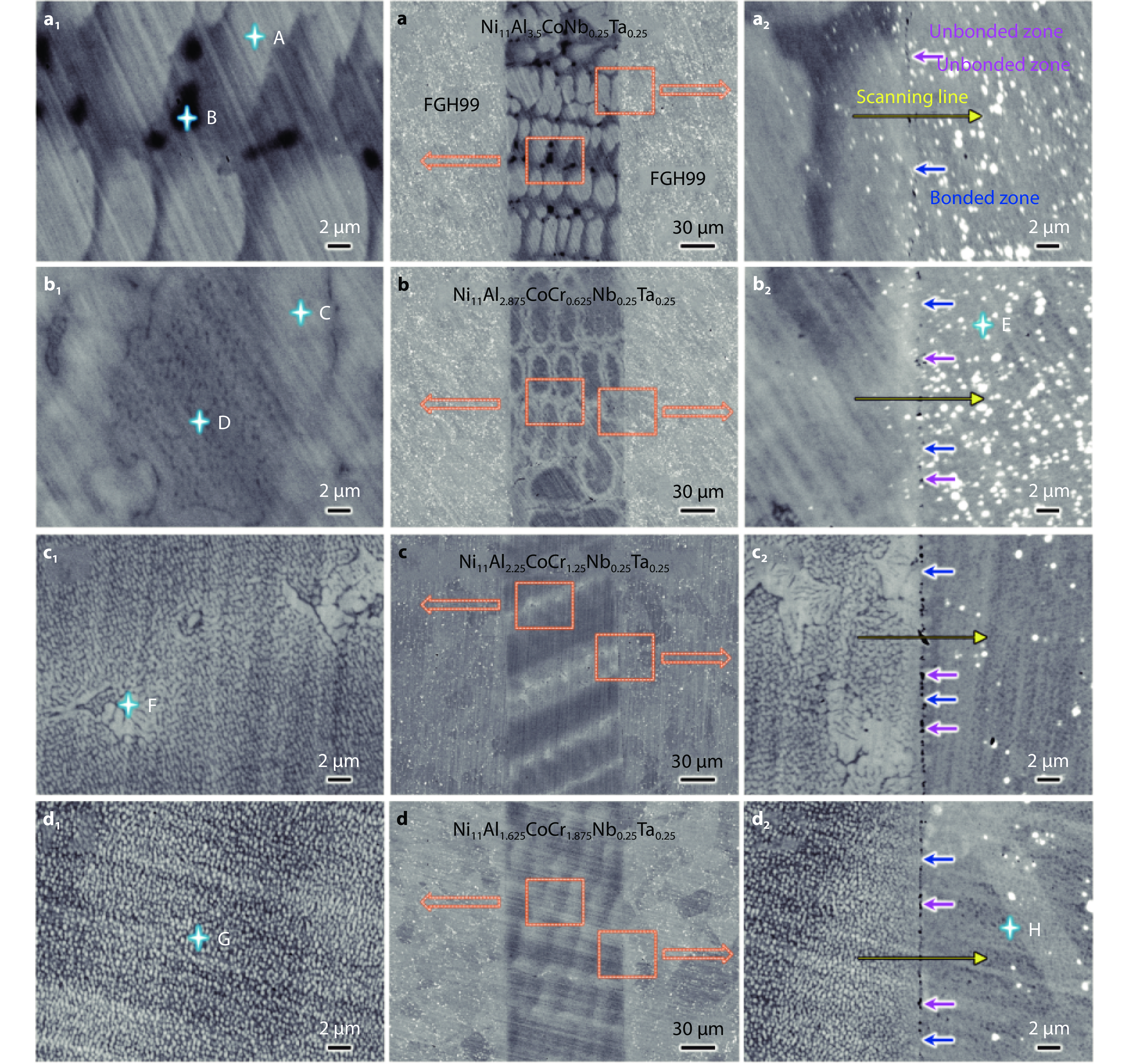
Figure 1.
Interface microstructure of FGH99 alloy was diffusion bonded by interlayers with different Cr content. a-a2 Cr0-Al3.5 interlayer. b-b2 Cr0.625-Al2.875 interlayer. c-c2 Cr1.25-Al2.25 interlayer. d-d2 Cr1.875-Al1.625 interlayer.
-
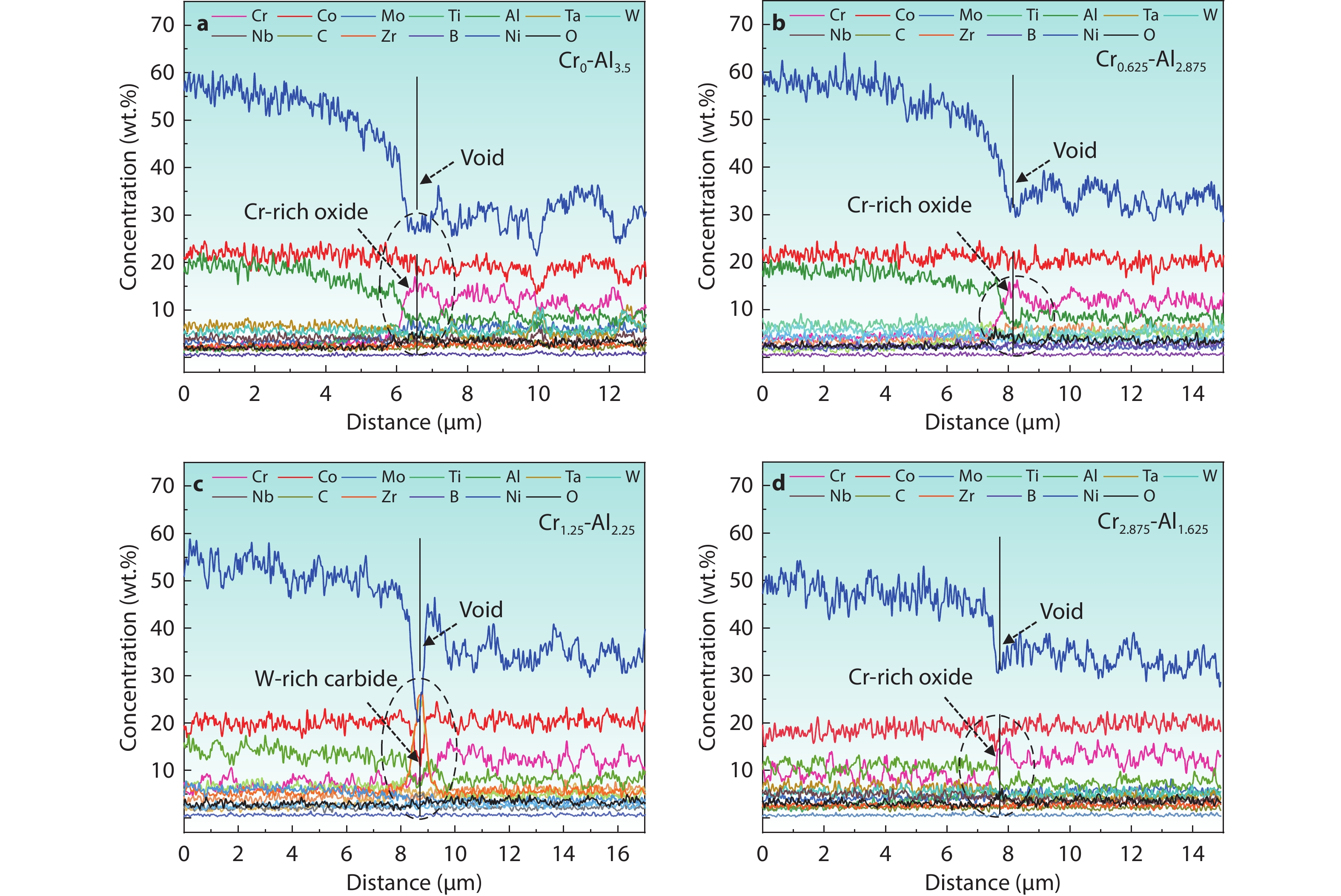
Figure 2.
Interfacial elemental line distribution of the joint bonded by interlayers with different Cr content. a Cr0-Al3.5 interlayer. b Cr0.625-Al2.875 interlayer. c Cr1.25-Al2.25 interlayer. d Cr1.875-Al1.625 interlayer.
-
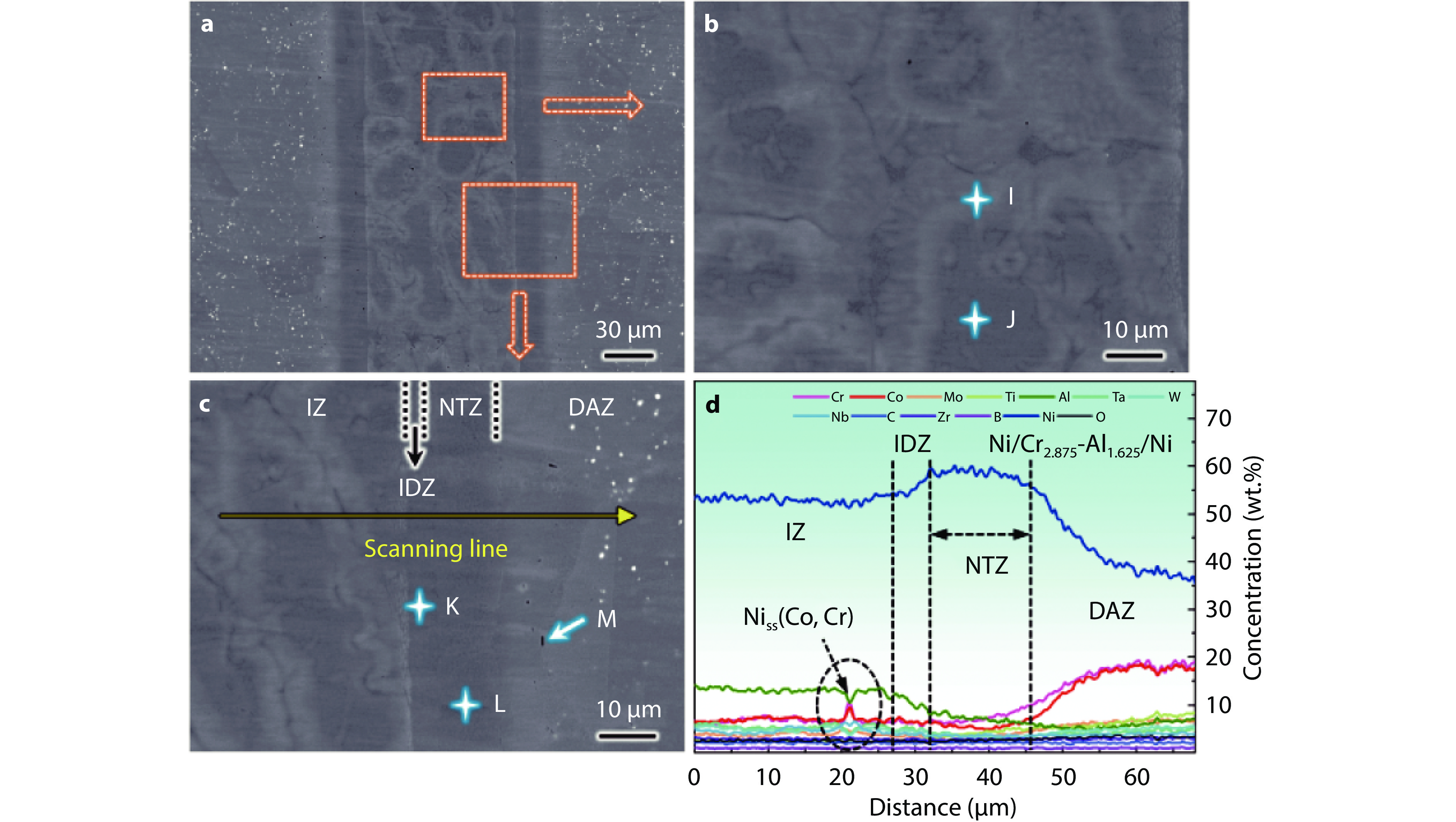
Figure 3.
Microstructure and elemental line distribution of the joint bonded with Ni/Cr0.625-Al2.875/Ni interlayer. a The cross-section image of typical interface. b The magnified view of zone in (a). d The elemental line distribution in (c).
-
Figure 4.
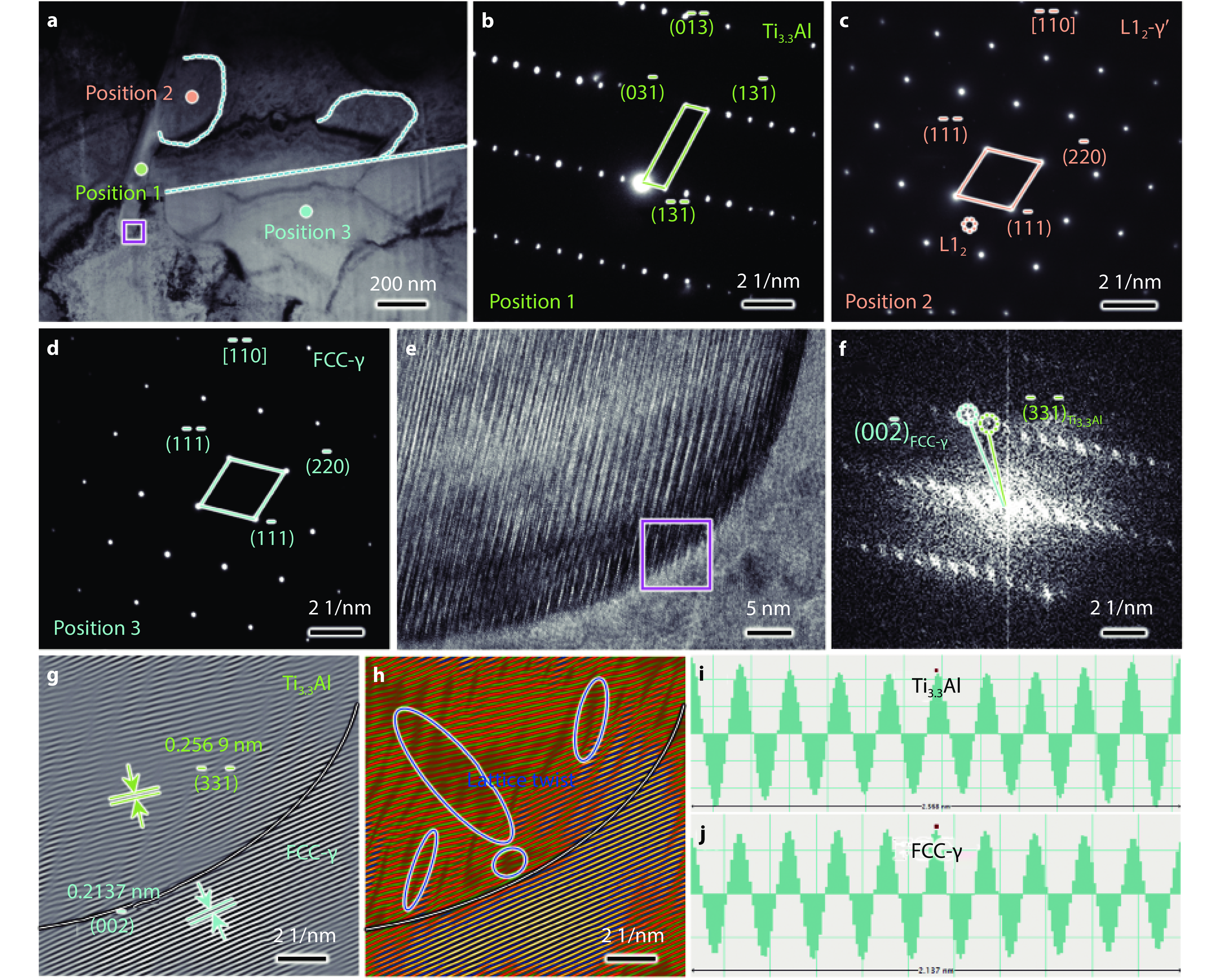
Atomic scale characterization of the interface in the DAZ of the joint bonded with Ni/Cr0.625-Al2.875/Ni interlayer under thermo-mechanical coupling. a Bright-field TEM image. b-d SAED patterns corresponding to the marked locations in a. e HRTEM image of pink region in a. f FFT and g IFFT pattern of pink region in e. h The corresponding lattice fringe reconstruction image of g. Intensity line profiles of individual atomic columns of i Ti3.3Al and j FCC-γ.
-
Figure 5.
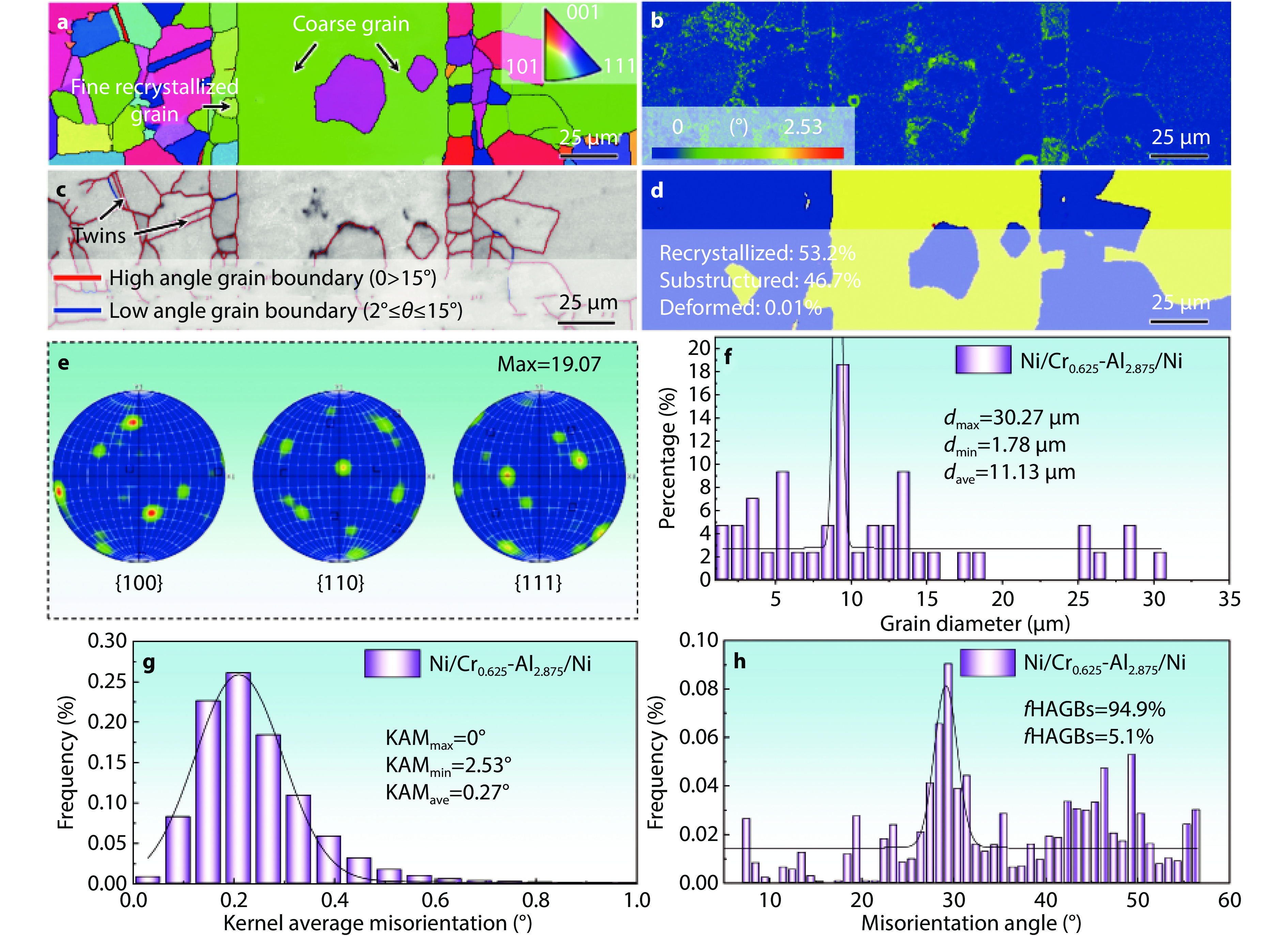
EBSD analysis results of the interface diffusion bonded with Ni/Cr0.625-Al2.875/Ni interlayer. a The results of inverse pole figure (IPF) and f The distribution of grain size. b The distribution of Kernel Average Misorientation (KAM) mapping and g its corresponding statistical results. c The distribution of HAGBs and low angle grain boundaries (LAGBs) and h its corresponding statistical results. d The distribution of recrystallized grain, substructure and deformed grain. e The results of PF.
-
Figure 6.
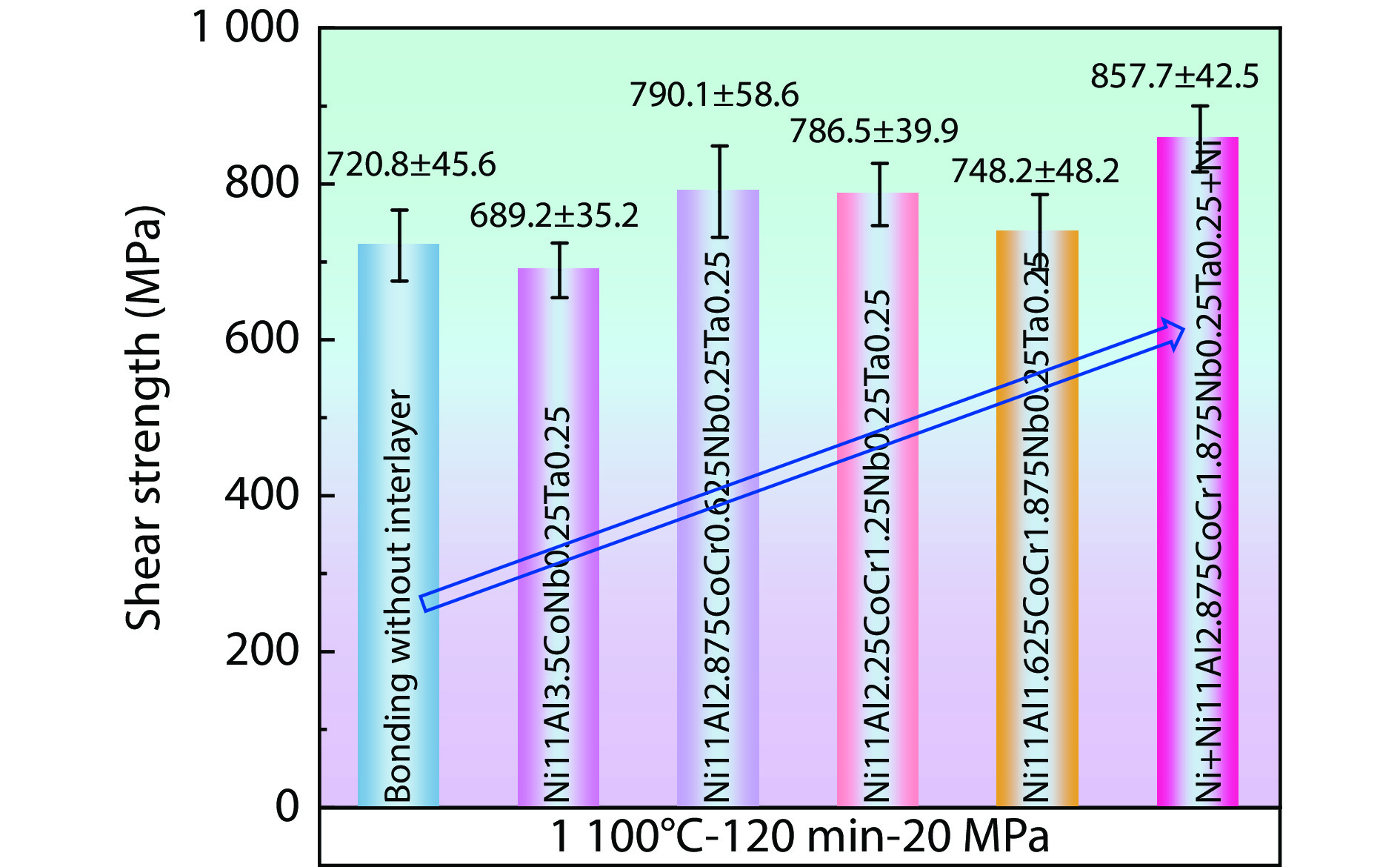
The shear strength of the joints with different interlayers bonded at
1100 °C-120 min-20 MPa. -
Figure 7.
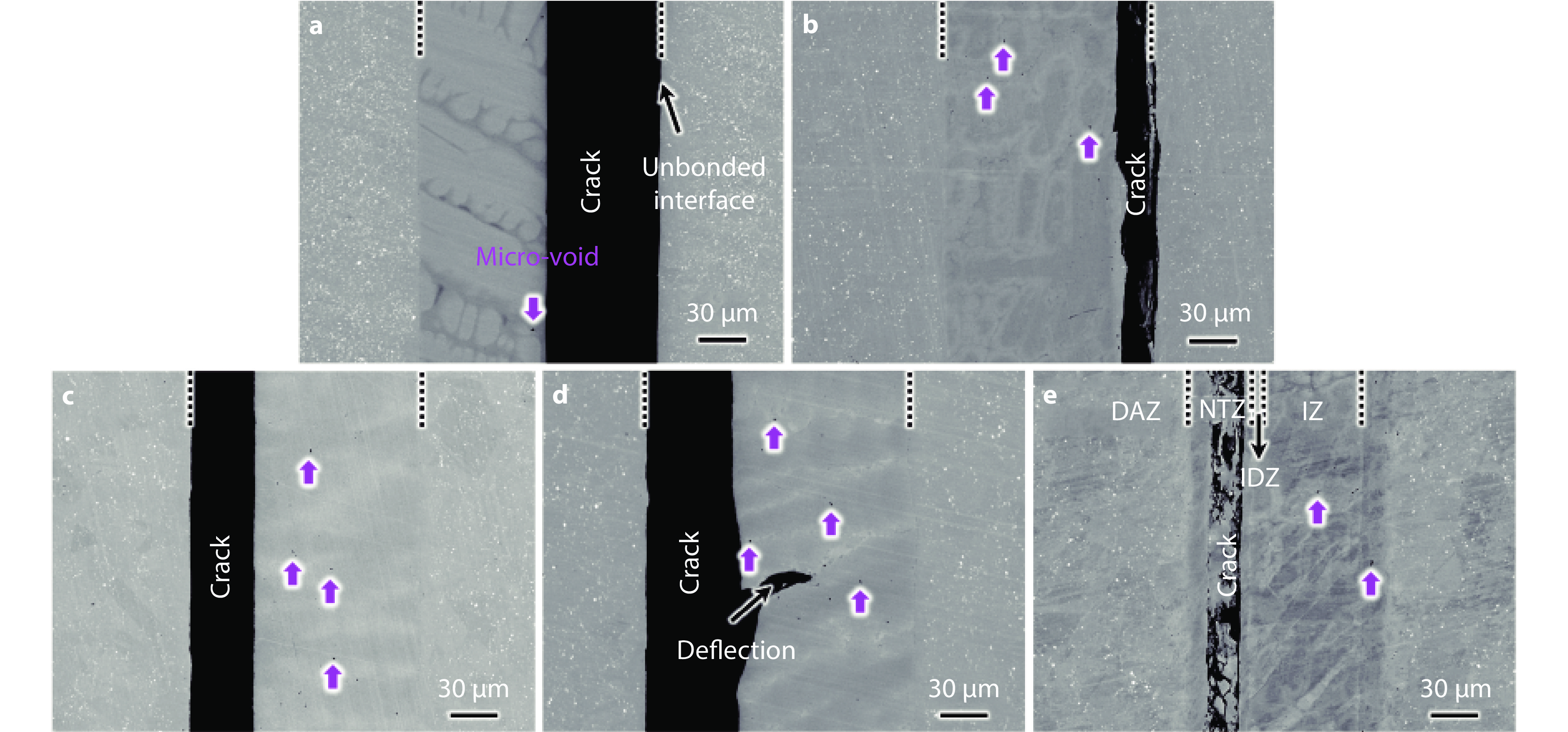
Fracture paths of the joints with different interlayers. a Cr0-Al3.5 interlayer. b Cr0.625-Al2.875 interlayer. c Cr1.25-Al2.25 interlayer. d Cr1.875-Al1.625 interlayer. e Ni/Cr0.625-Al2.875/Ni interlayer.
-
Figure 8.
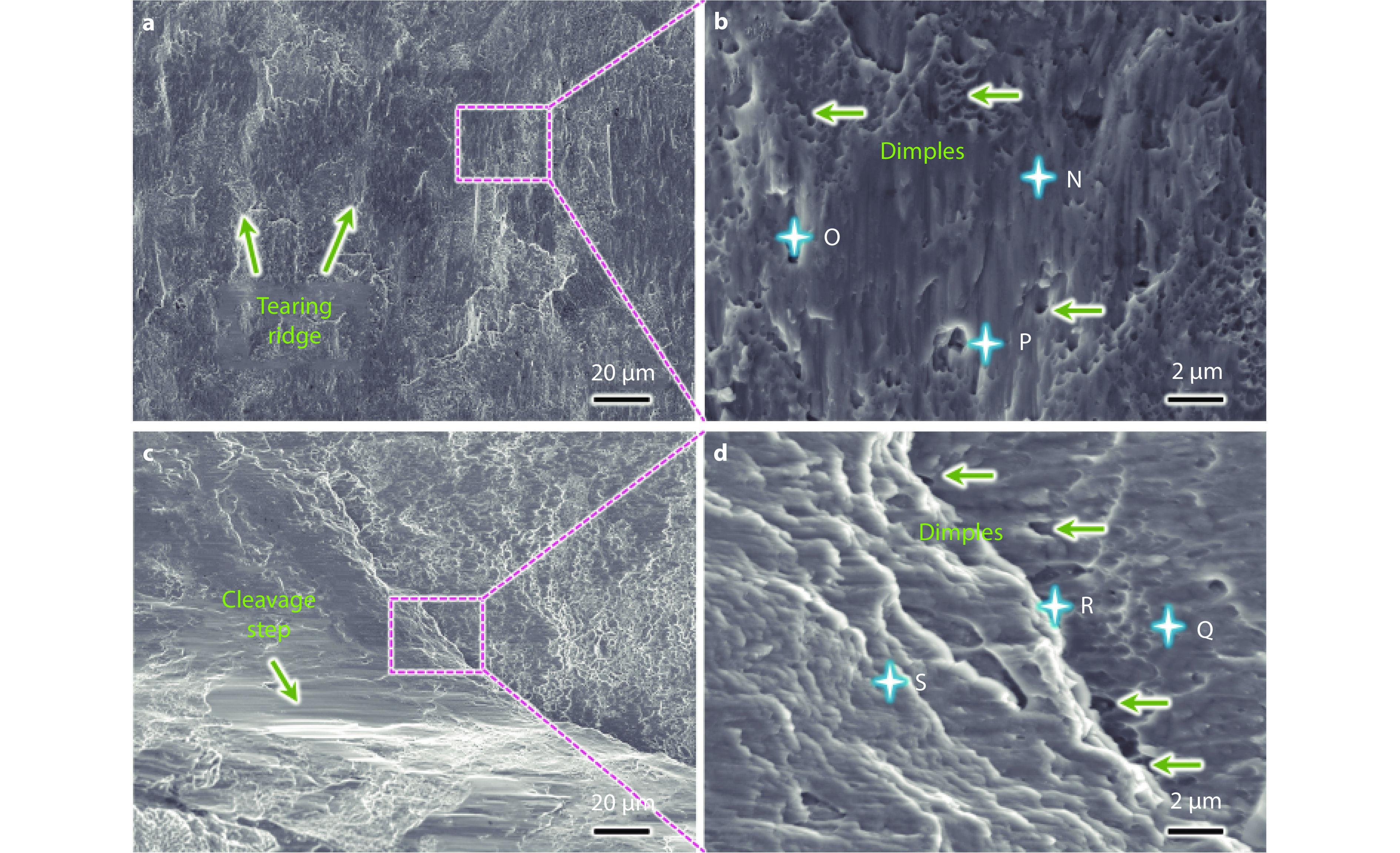
Fracture morphology of the joints with a-b Cr0.625-Al2.875 and c-d Ni/Cr0.625-Al2.875/Ni interlayer.
-
Figure 9.
Schematic diagram of the joint with sandwich-structured interlayer. a Initial plastic deformation. b Surface source diffusion and interface source diffusion. c GB diffusion and grain growth. d Well bonded joint with alternating coarse- and fine-grain layers, γ'-Ni3Al phase, and γ'-Ni3(Al,Ti) phase.